
The Fairy-Tale City Prague
I asked myself what the best way to start a day could be, and in the end I decided on one clear answer: waking up in Prague, the city of Franz Kafka. Imagine a dream you’re having at the most beautiful moment of your sleep continuing even after you wake up—that’s exactly what Prague feels like. Now grab your coffee, lean back, and get ready to experience Prague. Let’s begin…
A Brief Look at Its History
Prague, the capital of the Czech Republic, is also considered the heart of Central Europe and has played a remarkably important role on the stage of history. The country’s roots go back to the Kingdom of Bohemia, founded in the 9th century, which became one of Europe’s major cultural and commercial centers during the Middle Ages. In the 14th century, under the reign of Holy Roman Emperor Charles IV, Prague experienced its golden age. Gothic castles, bridges, towers, and educational institutions were added to the city, shaping much of the Prague we admire today.
Prague’s story during World War II is at least as striking as its architecture. When Nazi Germany occupied Czechoslovakia in 1939, Prague held a special place in Hitler’s eyes. Its Gothic character, its status as one of Europe’s most beautiful capitals, and the fact that it wasn’t as strategically industrial as cities like Berlin or Dresden meant that it largely survived intact. However, the widespread myth that “Prague was never bombed” isn’t entirely true. The city was bombed several times in 1944 and 1945; civilians lost their lives and certain areas were damaged. Still, because Prague avoided the level of destruction seen in many other European cities, walking its streets today feels like wandering through a medieval open-air museum.
After the war, Czechoslovakia was re-established in 1945 (though some territories were ceded to the Soviet Union). In 1989, the Velvet Revolution peacefully ended the communist one-party regime through mass protests and strikes. Then, in 1993, Czechoslovakia split peacefully into two countries, and the Czech Republic gained its independence.
Today, Prague Kafka’s city has passed through all these turbulent eras and yet continues to preserve its fairy-tale atmosphere, standing proudly against time.
Architecture and Atmosphere
Architecturally, Prague is dominated by Gothic style, accompanied everywhere by Baroque, Romanesque, and Renaissance influences. The city feels like a fairy tale that slowly pulls you in; every street feels like a new story, every corner like a song intertwined with art. Just as a tree’s roots spread deep into the soil, Prague draws you in step by step each street and every corner offering a new sense of discovery and wonder.
City Layout and Transportation
If you enjoy exploring on foot, Prague is pure paradise. Its compact layout, wide sidewalks, green belts stretching along avenues, and massive parks scattered throughout the city make walking a true pleasure. Old Town, with its narrow streets, feels like a labyrinth where every corner hides a new surprise. While the city preserves its medieval fabric, it’s also enriched with thoughtful modern touches.
Getting around is easy: metro lines, trams, and buses take you everywhere. But trust me discovering Prague on foot is a completely different experience. Getting lost on cobblestone streets, weaving between historic buildings and cafés, you feel the city’s soul in the deepest way.
We land at Václav Havel Airport and take our first step into Prague’s magical world. The first question, of course, is how to reach the city center. Taxis, as anywhere in the world, are quite expensive. A much better alternative is public transportation. With a bus and metro transfer, you can easily reach the center. Just remember to buy and validate your ticket beforehand. Take bus 119, get off at Veleslavín, transfer to the metro, and once you step out at Můstek, you’ll find yourself right in the heart of magical Prague.
You can’t leave Prague without trying local flavors. Czech cuisine is famous for its meat dishes and desserts especially svíčková (meat in creamy sauce) and goulash, both classics of the city. As for dessert, trdelník might be a bit of a tourist trap, but it’s still worth trying at least once. For all of this, Česká Kuchyně Restaurant is a great choice. And after your meal, you can fully embrace Czech culture by enjoying Prague’s famous beers at the city’s street pubs.
Daily Life in Prague
On almost every corner, a street musician reminds you of the city’s artistic soul. Watching people stand nearby with beers in hand, listening and chatting, shows how simple it can be to enjoy life fully. And when night falls… Prague is one of Europe’s liveliest cities after dark. There’s always a festival, concert, or event happening somewhere. In short, the city draws you in at night just as much as it does during the day.
Now we’re ready to step into Prague’s streets and begin our journey. One of the most beautiful things about this fairy-tale city is the feeling that you’re walking through medieval streets in a vast open-air museum. Wandering through streets that look like they’ve leapt out of a storybook, you can’t help but feel enchanted.
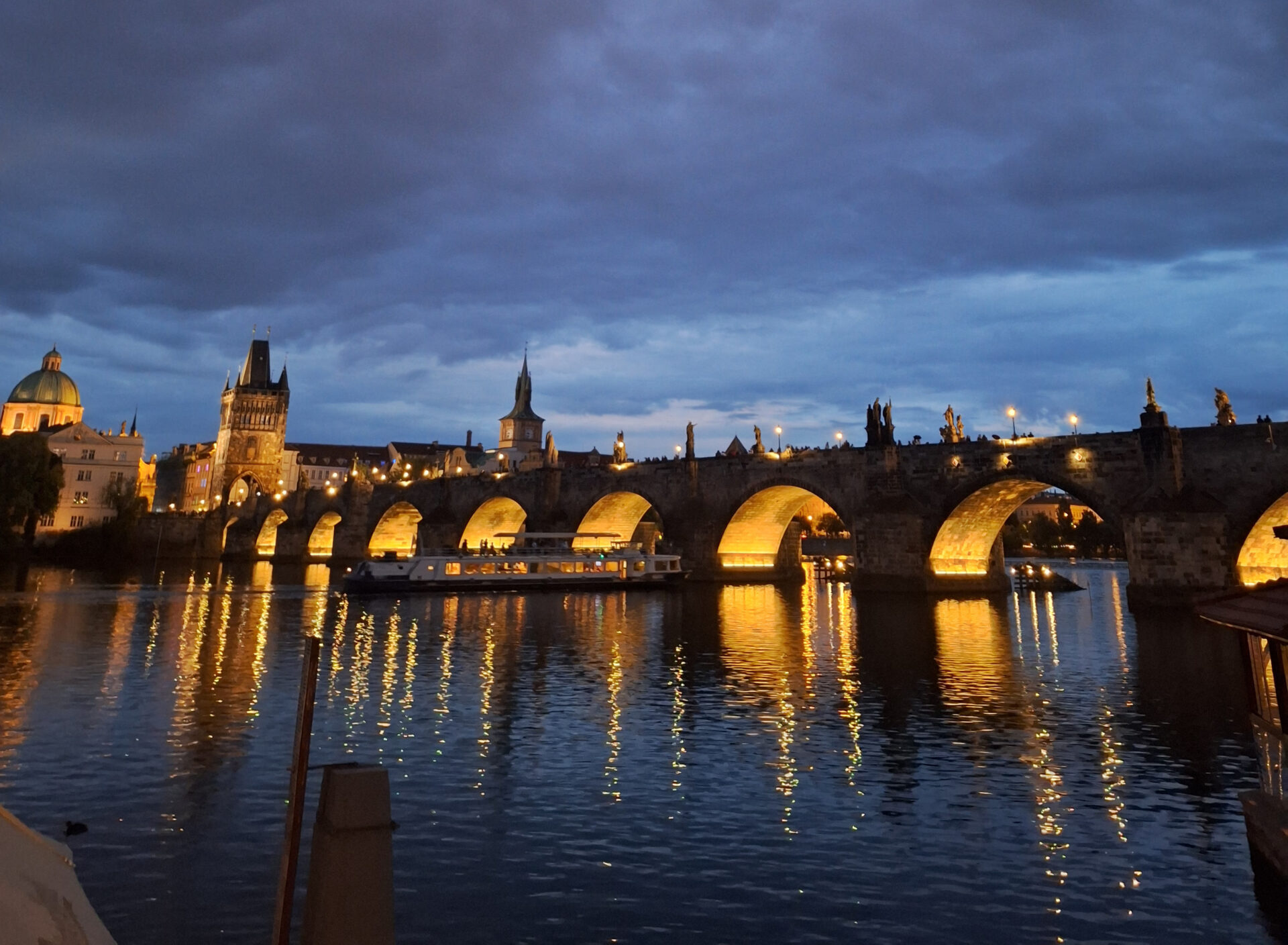
Your first likely stop in Prague will be Charles Bridge (Karlův Most). Built in 1357 by Charles IV, this Gothic bridge connects the two banks of the Vltava River. The mystical statues lining the bridge and the view of Prague Castle on the hill make you feel like you’re inside a fairy tale. Being here early in the morning, surrounded by Prague’s mist, or sitting in a café overlooking the bridge in the evening, is an unforgettable experience.
We cross the bridge and set our sights on Pražský Hrad (Prague Castle) but first, there’s a fairly steep uphill climb. Still, the walk is so enjoyable that you lose track of time as you ascend through medieval streets. Along the way, St. Nicholas Church (Kostel sv. Mikuláše) appears before you, one of the most magnificent examples of Baroque architecture in Prague. Its ceiling frescoes, gold details, and perfect acoustics are mesmerizing. Attending a Vivaldi concert here in the evening is an absolute must.
And finally, the heart of Prague: Prague Castle and St. Vitus Cathedral.
Founded in the 9th century, the castle has witnessed countless eras from Bohemian kings to Holy Roman Emperors, and today, Czech presidents. It has endured fires, wars, and invasions, yet has been reborn time and again. That’s why you can see traces of Romanesque, Gothic, Baroque, and Renaissance styles all in one place.
St. Vitus Cathedral, located within the castle complex, is one of the most impressive examples of Gothic architecture. Its enormous stained-glass windows, the breathtaking city view from the tower, and the tombs of Bohemian kings inside make it truly awe-inspiring. As you descend from the castle, you’ll catch some of the most beautiful panoramic views of Prague. Along the way, Waldstein Garden (Valdštejnská zahrada) a Baroque garden built in the 1620s offers a peaceful stop with its statues, fountains, and elegant landscaping.
Another iconic stop is the Lennon Wall. First painted in the 1980s by young people inspired by John Lennon’s messages of peace and freedom, it became a protest space against the communist regime of the time. Over the years, with contributions from visitors, it has turned into a colorful symbol where everyone leaves their own message and mark.
In a quiet corner of the city, St. Ludmila Basilica (Bazilika svaté Ludmily) offers a completely different kind of peace. Built in 1892 in Neo-Gothic style and dedicated to Saint Ludmila, the first Christian saint of the Czech lands, it has become a symbol of the Vinohrady district with its twin towers. Sitting in the park in front of it, listening to music, is one of the most tranquil things you can do in Prague.
Let’s jump to more modern times: The Dancing House.
Rising along the Vltava River, this symbol of modern architecture was designed in 1996 by Frank Gehry and Vlado Milunić. Its curved lines resemble a dancing couple, creating a striking contrast with Prague’s historic fabric and offering fascinating photo opportunities.
And of course, the heart of Prague: the Astronomical Clock (Orloj) and the Church of Our Lady before Týn beside it.
Built in 1410 by clockmaker Mikuláš of Kadaň and astronomer Jan Šindel, the Astronomical Clock doesn’t just tell time it shows the position of the sun and moon, zodiac signs, and the calendar.
Legend has it that the clock’s maker was blinded so he couldn’t build a similar one elsewhere. In revenge, he allegedly sabotaged the mechanism, causing the clock to stop working for years leaving the city “timeless.” Even today, every hour, the figure of Death rings the bell and the twelve apostles appear in the windows. The square falls silent, the melody echoes, and Prague’s magic comes alive once again.
Right next to it rises the Týn Cathedral, a Gothic masterpiece completed in the 14th century, its towering spires defining the city’s skyline.
Prague… a city that whispers stories at every corner, enchanting you with violin sounds echoing through its stone streets.
Maybe that’s why Prague isn’t meant to be visited it’s meant to be lived. Sitting in a café watching people pass by, listening to the clock tower’s melody, or making a wish on a bridge, the city slowly becomes a part of you.
For me, this wasn’t just a trip it was a turning point.
With every word and every frame, my dream of “traveling the world” becomes a little more real.
Maybe it’s not perfect, but this is my story.
And perhaps what made Prague special wasn’t only what I saw but the streets I walked hand in hand with my dream.